
Facet Joint Pain: A Common Cause of Back and Neck Pain
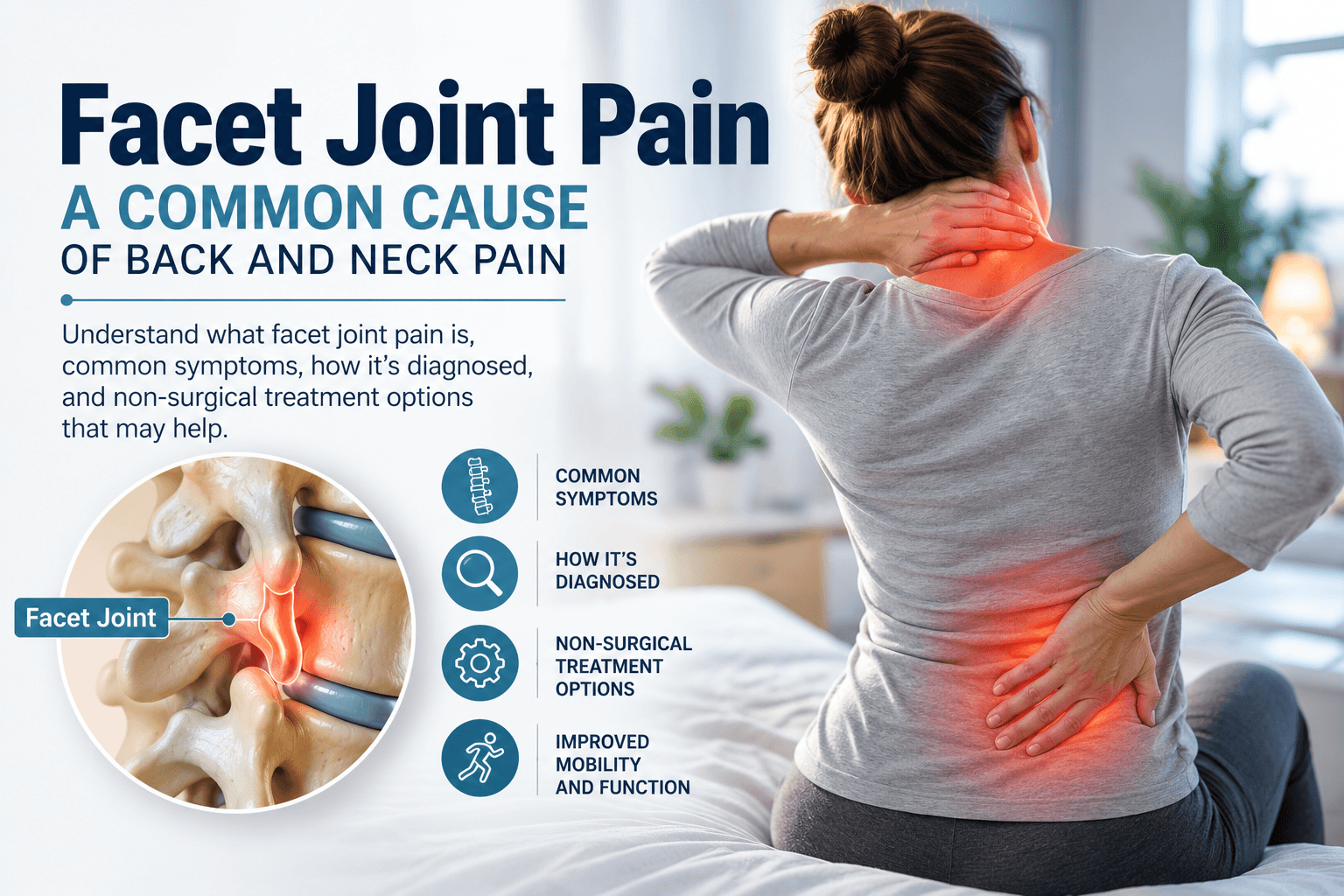
Persistent back or neck pain can come from several different structures within the spine. While discs and pinched nerves often receive much of the attention, the small joints connecting the vertebrae can also become a significant source of discomfort.
These structures are known as facet joints. When they become irritated, inflamed, injured, or affected by arthritis, they may cause facet joint pain that interferes with standing, walking, turning the head, exercising, or completing normal daily activities.
Because facet joint symptoms can resemble other spinal conditions, identifying the actual source of pain is an important part of developing an effective treatment plan.
What Are Facet Joints?
Facet joints are small joints located along the back of the spine. Each vertebra connects with the vertebra above and below it through a pair of facet joints.
These joints help:
- Provide stability to the spine
- Guide bending and twisting movements
- Prevent excessive motion between vertebrae
- Support normal movement of the neck and back
Like the knees, hips, and other joints in the body, facet joints contain cartilage and can develop inflammation, degeneration, or arthritis over time.
Patients interested in learning more about arthritis-related discomfort can also review our guide to arthritis pain treatment without surgery.
What Causes Facet Joint Pain?
Facet joint pain can develop for several reasons. In many patients, more than one factor may contribute.
Age-Related Changes
Cartilage within the facet joints may gradually wear down as part of the aging process. These changes can increase friction within the joint and contribute to inflammation, stiffness, and discomfort.
Age-related changes do not automatically cause pain. Many people have arthritis or degeneration visible on imaging without significant symptoms. A physician must consider imaging findings together with the patient’s history and physical examination.
Arthritis
Osteoarthritis can affect the facet joints just as it affects other joints throughout the body.
As cartilage changes, the joint may become irritated and less mobile. Bone spurs may also develop around the joint.
Previous Injury
A fall, motor vehicle collision, sports injury, or other trauma may damage or irritate the facet joints.
In some cases, pain begins soon after an injury. In others, changes within the joint may contribute to symptoms later.
Repetitive Stress
Repeated bending, twisting, lifting, or extending the spine may place additional stress on the facet joints.
This does not mean that normal movement is harmful. The spine is designed to move. However, repeated loading combined with arthritis, injury, or other spinal changes may contribute to symptoms in some patients.
Other Spinal Changes
Changes in spinal discs may alter how forces are distributed across the spine. When discs lose height or flexibility, the facet joints may experience additional stress.
This is one reason facet joint pain may occur alongside degenerative disc disease or other spinal conditions.
What Does Facet Joint Pain Feel Like?
Symptoms depend partly on whether the affected joints are located in the neck or lower back.
Facet joint pain is often described as an aching or localized discomfort rather than the burning, tingling, or shooting sensations more commonly associated with irritated nerves.
However, symptoms vary, and an examination is needed to distinguish one condition from another.
Symptoms of Lumbar Facet Joint Pain
Facet joints in the lower back are called lumbar facet joints.
Symptoms may include:
- Localized lower back pain
- Stiffness, particularly after inactivity
- Pain that worsens when standing for extended periods
- Discomfort when leaning backward
- Pain during twisting movements
- Aching that spreads into the buttocks or upper thighs
Facet-related lower back pain typically does not follow the same pattern as sciatica, which often travels farther down the leg because a spinal nerve is irritated.
For a broader overview of conditions affecting this area, read common causes of lower back pain and when to seek treatment.
Symptoms of Cervical Facet Joint Pain
The facet joints of the neck are known as cervical facet joints.
Possible symptoms include:
- Localized neck pain
- Stiffness or reduced range of motion
- Pain when turning or tilting the head
- Discomfort when looking upward
- Pain extending into the shoulders or upper back
- Headaches that begin near the base of the skull in some patients
Neck pain that travels down the arm with numbness, tingling, or weakness may suggest nerve involvement rather than isolated facet joint pain and should be evaluated accordingly.
What Movements Can Make Facet Joint Pain Worse?
Facet joint symptoms may become more noticeable during movements that place additional pressure on the affected joints.
Depending on the area involved, this may include:
- Leaning backward
- Twisting the spine
- Turning the head
- Standing for prolonged periods
- Transitioning from sitting to standing
- Certain sports or repetitive activities
Symptoms alone cannot confirm that a facet joint is the source of pain. Disc problems, muscle strain, sacroiliac joint pain, spinal stenosis, and other conditions may cause overlapping symptoms.
How Is Facet Joint Pain Diagnosed?
Diagnosing facet joint pain usually begins with a detailed history and physical examination.
Your physician may ask:
- Where the pain is located
- When the symptoms began
- Which movements make the pain better or worse
- Whether pain travels into an arm or leg
- Whether numbness, tingling, or weakness is present
- Which treatments you have already tried
- How pain affects work, sleep, exercise, or daily activity
The physical examination may assess spinal movement, areas of tenderness, strength, sensation, reflexes, and movements that reproduce the patient’s usual symptoms.
Do You Need an MRI or X-Ray?
Imaging may help identify arthritis, degenerative changes, fractures, disc problems, or other structural conditions within the spine.
An X-ray may show:
- Arthritis
- Bone spurs
- Changes in spinal alignment
- Loss of disc height
An MRI may provide additional detail about discs, nerves, soft tissues, and other spinal structures.
However, imaging cannot always determine whether a particular facet joint is actually causing pain. Many spinal changes occur without producing symptoms.
This is why diagnostic procedures may sometimes be needed in addition to imaging.
What Is a Medial Branch Block?
Small nerves called medial branch nerves carry pain signals from the facet joints.
When a physician suspects facet joint pain, a diagnostic medial branch block may be used to temporarily numb the nerves connected to the suspected joint.
If the patient experiences meaningful temporary relief while those nerves are numb, the response can provide evidence that the facet joint is contributing to the pain.
This information may also help determine whether another treatment, such as radiofrequency ablation, should be considered.
Learn more about how diagnostic procedures work in our guide to nerve blocks for pain.
Conservative Treatment for Facet Joint Pain
Many patients begin treatment with non-surgical approaches.
Depending on the individual condition, conservative care may include:
- Temporary activity modification
- Physical therapy
- Home exercise
- Improving strength and mobility
- Heat or cold therapy
- Anti-inflammatory or other medications when appropriate
The goal is generally to maintain appropriate movement while reducing activities that consistently aggravate symptoms.
Physical Therapy and Exercise
Physical therapy may help patients improve spinal mobility, strength, posture, and tolerance for activity.
A program may include:
- Core strengthening
- Neck or back mobility exercises
- Hip and shoulder strengthening
- Postural endurance
- Movement and lifting strategies
- Gradual return to normal activity
Exercise should be individualized. A movement that helps one patient may aggravate another condition, particularly when multiple pain generators are involved.
Medications for Facet Joint Pain
Medication may be used as part of a broader treatment plan.
Depending on the patient’s medical history, options may include:
- Acetaminophen
- Nonsteroidal anti-inflammatory medications
- Topical pain-relieving medications
- Other prescription medications when appropriate
Medication does not reverse arthritis within the facet joints and may not address the underlying source of persistent pain.
Patients should discuss medication options with a healthcare professional, particularly when they have kidney disease, heart disease, gastrointestinal problems, medication interactions, or other health concerns.
Facet Joint Injections
In selected patients, a physician may recommend an injection involving the facet joint or nearby structures.
These procedures may serve different purposes depending on the patient’s diagnosis and treatment plan.
Some injections are intended to provide diagnostic information, while others may be used therapeutically to reduce inflammation or discomfort.
Imaging guidance may be used to help accurately position the needle during spinal procedures.
Radiofrequency Ablation for Facet Joint Pain
If diagnostic medial branch blocks indicate that particular nerves are transmitting pain from a facet joint, radiofrequency ablation may be considered.
Radiofrequency ablation uses controlled energy to reduce the ability of selected medial branch nerves to transmit pain signals.
The procedure does not remove the facet joint or reverse arthritis. Instead, it is intended to reduce pain signaling from the affected area.
When successful, reduced pain may help patients move more comfortably, participate in physical therapy, exercise, and return to activities that had become difficult.
Because nerves can regenerate, the effect is generally not considered permanent, and results vary among patients.
How Is Facet Joint Pain Different From a Pinched Nerve?
Facet joint pain and an irritated spinal nerve can occur in the same area but often produce different symptoms.
Facet pain is more commonly associated with localized aching, stiffness, and discomfort during certain movements.
Nerve irritation may cause:
- Burning or shooting pain
- Numbness
- Tingling
- Weakness
- Pain that travels farther into an arm or leg
For patients with radiating leg symptoms, sciatica is one possible cause. When inflammation around a spinal nerve is involved, treatments such as epidural steroid injections may be considered in appropriately selected patients.
When Should You See a Pain Management Physician?
Consider scheduling an evaluation when back or neck pain:
- Persists despite conservative care
- Continues to return
- Limits exercise or normal activity
- Interferes with work or sleep
- Worsens with particular spinal movements
- Has not been clearly diagnosed
- Is affecting your overall quality of life
If pain has persisted for several months, it may also be helpful to understand when pain becomes chronic and why persistent symptoms may require a broader treatment approach.
When Back or Neck Pain Needs Prompt Attention
Not all spinal pain is caused by facet joints.
Seek prompt medical attention for symptoms such as:
- New or progressive weakness
- Loss of bowel or bladder control
- Difficulty walking or maintaining balance
- Severe pain after significant trauma
- Fever with severe spinal pain
- Unexplained weight loss
- Rapidly worsening neurological symptoms
These symptoms may indicate a condition requiring more urgent evaluation.
Finding the Source of Persistent Back or Neck Pain
Facet joint pain is one of several potential causes of chronic back and neck discomfort. Because symptoms frequently overlap with other spinal conditions, treatment should begin with identifying the structures most likely responsible for the pain.
A personalized plan may involve physical therapy, activity modification, medication, diagnostic nerve blocks, injections, radiofrequency ablation, or another approach based on the patient’s individual findings and goals.
Evolve Pain Management provides individualized evaluation and interventional pain treatment for patients in Huntersville and throughout the Lake Norman area, including Cornelius, Davidson, and Denver.
Patients experiencing persistent back or neck pain can request an appointment to discuss their symptoms and determine which treatment options may be appropriate.